A quiet change is happening in how people find and buy things. Instead of opening a search engine or a store, some shoppers now ask an AI. They type something like "find me good running shoes under fifty dollars" into ChatGPT or Google, and the AI does the looking for them.
Underneath that simple experience sit two standards you may have started hearing about: UCP and ACP. They are not products you buy or code you write. They are the shared rules that let AI assistants and online stores talk to each other. This piece walks through what they are, who built them, and what they mean for Indian brands right now. No hype, just a clear picture.
What agentic commerce actually means
Agentic commerce is a simple idea with a slightly technical name. An AI agent, like ChatGPT or Google's Gemini, helps a shopper through the buying journey. It understands what they want, shows suitable products, answers questions, and in some cases helps complete the purchase, all inside the chat.
Think of it as a new shelf. For years, brands competed for space on Google search, on Instagram, and on marketplaces. AI chat is now becoming another place where people discover products. The shopper asks, the AI suggests, and a sale can follow.
One thing stays the same through all of this. The brand is still the seller. It keeps the customer, the order, and the data. The AI is simply the new place where the shopper found them.
The two protocols, and who built them
For AI agents and stores to work together smoothly, they need a common language. Right now there are two main ones.
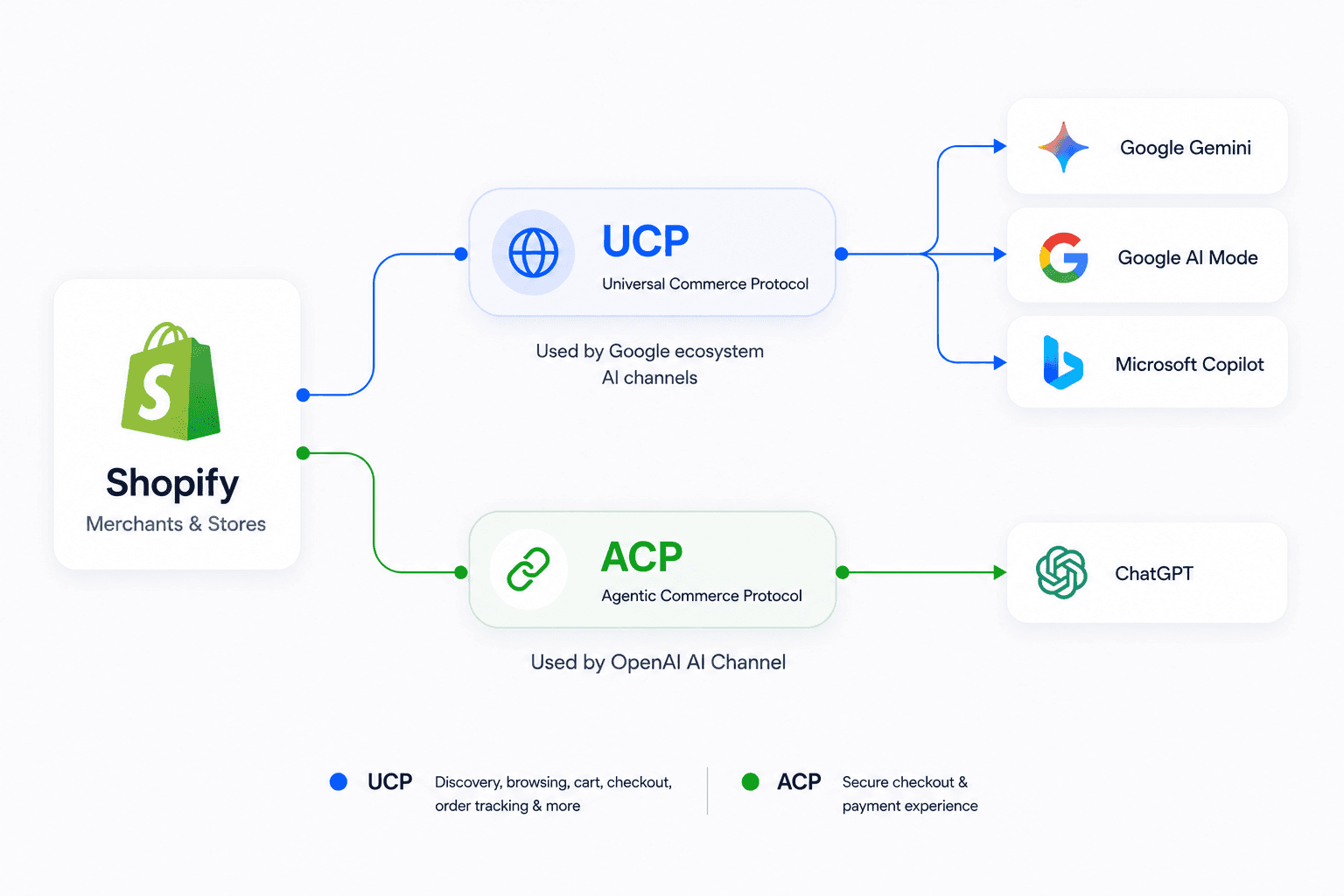
The first is UCP, the Universal Commerce Protocol. Shopify and Google built it together as an open standard. UCP is broad. It covers the whole journey, from discovering a product, to building a cart, to checkout, to tracking the order afterward.
The second is ACP, the Agentic Commerce Protocol. It was built by OpenAI and Stripe, and Stripe now lists Meta as involved too. ACP is narrower by design. It focuses on the checkout step, the part where a shopper actually pays. It is open source, so any business or AI platform can adopt it.
Which AI uses which? In simple terms, Google's AI Mode, Gemini, and Microsoft Copilot lean on UCP, while ChatGPT uses ACP. Shopify supports both, which matters for the next point.
Here is the reassuring part for any brand. You do not build either protocol. Shopify handles the connections behind the scenes. A merchant on Shopify turns on the AI channels from the admin, and Shopify takes care of whichever language each surface speaks. So the names are useful to understand, but they are not something a store owner has to manage directly.
How each one handles checkout and payment
The two protocols share a goal, letting a shopper buy through an AI, but they approach payment a little differently. Both are worth understanding at a high level.
UCP treats payment as something to be agreed on for each sale, rather than fixed in advance. A store says which payment methods it accepts, and the agent picks one that works. Shop Pay is built in as one option, and other payment providers can add their own. The idea is flexibility: the right method can shift based on the cart, the buyer, or the region.
ACP uses a neat mechanism called a Shared Payment Token. When a shopper is ready to buy inside the AI, they choose a payment method there. Their payment provider then issues a single-use token that is limited to that one merchant and that one amount. The agent passes this token to the store, and the store charges it through its own payment processor. The shopper's real card details never reach the AI or the store. It is a careful way to keep a purchase secure while letting it happen inside a chat.
Across both, one principle holds firm. The brand remains the merchant of record. It decides what is sold, how it appears, and how orders are handled. The protocol is plumbing, not a middleman that takes over the relationship.
What this means for Indian brands
Here is where it gets practical, and where honesty matters more than excitement.
Two conditions shape what is possible today, and both currently point at the United States. First, to appear in these AI shopping results, a store needs to sell to customers in the US. A store based in India can take part, as long as it sells to US shoppers. Second, the AI shopping experience itself is live mainly for shoppers in the US for now, and is expected to reach more regions over time.
There is also a payment reality to be clear about. Shopify Payments is not available in India. The payment rails that power in-chat buying today, Shop Pay on the UCP side and Stripe's Shared Payment Token on the ACP side, are US-centric. So an Indian brand cannot yet offer a shopper the option to pay inside the AI chat itself.
That sounds like a wall, but it is more of a detour. Discovery still works. An Indian brand that sells to US customers can be found inside these AI surfaces. When a shopper is ready to buy, they are simply sent to the brand's own store checkout, where they pay the normal way through the brand's usual gateway, such as Razorpay, Cashfree, or PayU. The sale still happens. It just completes on the store, not in the chat.
The short version: for Indian brands today, this is mostly a way to be discovered by US shoppers, with the purchase finishing on your own checkout. The in-chat payment part will open up more once the payment infrastructure reaches India.
What Indian brands can work on now
The good news is that the most useful preparation has nothing to do with protocols. It is about having a clean, clear store that an AI can understand. Three areas are worth attention.
The first is the Agentic section in the Shopify admin. This is where a brand manages its AI channels, chooses which ones can use its product data, and sees which AI brought in a sale. It is the control panel for all of this, and it is a sensible first place to look.
The second is the Knowledge Base app. Shoppers ask questions before they buy: about sizing, returns, shipping, and product details. The Knowledge Base lets a brand give the AI good answers to these questions, so the assistant can respond helpfully instead of guessing or staying silent.
The third, and probably the most valuable, is getting the product catalog ready. AI assistants recommend products they understand well. That means clear titles written the way a shopper would search, natural descriptions that answer real questions, complete product details like material and size, accurate stock and pricing, and good images. A product with thin or messy information is hard for an AI to trust, so it tends to get passed over. Clean data is quietly the strongest thing a brand can work on.
None of this requires a rebuild. It is careful, ordinary store hygiene, done with AI readers in mind as well as human ones.
Where this leaves us
Agentic commerce is still early, and the picture will keep shifting as the protocols mature and the regions expand. For now, the sensible posture is to understand how it works, watch how it develops, and get the basics right.
If there is one place to start, it is the product catalog. Clear, accurate, well-organized product information helps you today with search and shoppers, and it is exactly what these AI surfaces will lean on tomorrow. That is a good use of effort no matter how quickly the rest of this arrives.