There is a strange conversation happening inside every company right now.
Ask any individual, an engineer, a marketer, a lawyer, whether AI makes them faster and you get a lived, emphatic yes. The report that took an afternoon instead of a week. The contract summary that used to eat a Saturday. I personally believe I am 3x more productive compared to what I could get done in December 2025. Then ask the leadership to show you where all that speed landed in the P&L, and you get silence.
You have seen the public version of this argument: token bills doubling every few weeks against single-digit measured productivity, an S&P earnings lift from AI that rounds to somewhere between zero and two percent once you exclude the shovel-sellers, while the other side shrugs that we are so early nobody should care. Robert Solow watched this exact movie in 1987 when he quipped that you could see the computer age everywhere except in the productivity statistics.
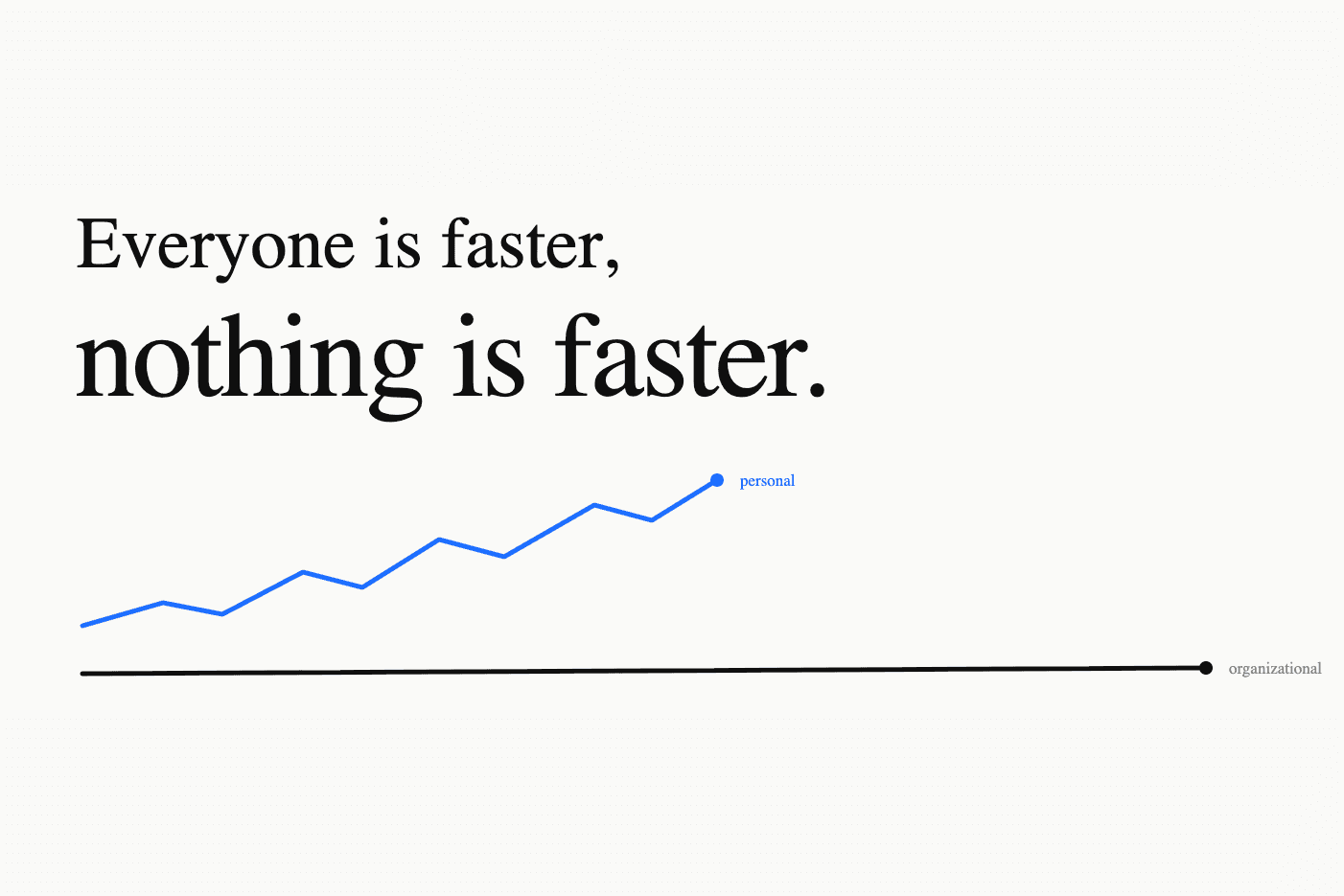
Here is the thing: both sides are right, and the interesting question is how. The answer is the gap between personal productivity and organizational productivity
I.
Start with the mechanism. A person is a task. An organization is a system. That one sentence explains most of the missing ROI.
Suppose an analyst's report now takes half a day instead of three. The approval still waits for Thursday's committee. The next team planned its capacity assuming the three-day version. The client was quoted the old timeline and nobody rewrote the quote. The saved days did not vanish; they dissolved into the seams, into queues, handoffs, and waiting. Speed up one station on an assembly line by ten times and the line's output barely moves. Organizations are lines, not stations.
There is a second, more human reason. Individual gains accrue privately by default. An employee who becomes forty percent faster does not mail the surplus to finance. They raise quality, take on a side task, or leave at six instead of eight. Much of that is genuinely valuable. But comfort does not appear in EPS.
So personal productivity is simultaneously real and invisible, and the two camps are talking past each other. The gains exist. They have not been collected. Collection is a management act, not a technology event: capacity re-planned around the new speed, service levels rewritten, workflows redesigned so the freed hours flow somewhere deliberate, pricing that reflects what delivery now costs. The companies that show AI in their earnings first will not be the ones with the biggest token bills. They will be the ones whose leaders treated the surplus as something to redeploy rather than something to admire.
II.
Should you keep spending while the translation is incomplete? The uncomfortable answer: most enterprise AI spend today might have no provable immediate ROI, and that matters less than it appears.
The visible purchase is tokens. The invisible purchase is a learning curve: knowledge of where AI actually works in your business, evaluation muscle, data plumbing, a workforce that reaches for the tool by reflex. That asset compounds and cannot be bought later at any price. Two years of messy experiments is tuition, not waste.
But tuition deserves a budget, not a blank check. Spend on immature use cases behaves like exploration: it belongs on the most capable models and should be judged on what you learn. Spend on mature use cases behaves like operations: judged ruthlessly on cost per outcome, optimized without sentiment. The companies in trouble are running operations-scale bills with exploration-level discipline. And remember, you do not get to run the counterfactual. By the time the ROI is provable in public numbers, the cheap years of building the capability will be over.
III.
Now the money itself. I spent a decade in cloud, so I have seen this movie: the bill arrives, the CFO gasps, a discipline is born. FinOps turned the 2014 cloud panic into a profession. The same profession is being invented for tokens, except the physics are stranger.
You already know the paradox: per-token prices fall ninety percent a year and bills keep doubling anyway, because usage grows faster than price falls. Both trends continue. The part most enterprises have not internalized is that the unit that matters is not the token, it is the completed task. The meter is not the machine. Failure changes all the math. A cheap model that breaks three hours into a long agentic task burns the tokens and the time, and you pull the lever again. When an agent replaces two hundred dollars an hour of skilled labor, the gap between three dollars of budget inference and fifteen dollars of frontier inference is a rounding error; the gap between finishing and failing is the entire economics. This is why long-horizon work keeps concentrating at the frontier no matter what the benchmarks say, while precisely specified workloads migrate down to small post-trained models at commodity cost.
One more underpriced variable: the harness. The scaffolding around the model can change the cost of the same task on the same model by a factor of two. So the instrumentation that matters is not a token dashboard. It is cost per outcome, per task, per model, per harness, with evals as the quality control. Build that, and the CFO conversation turns from an interrogation into a review.
IV.
So where does this market go? A directional view, held loosely.
The market barbells. Frontier models keep the premium end: immature use cases and long agentic work where failure cost dwarfs inference cost. Commodity and open models absorb the mature middle as workloads get specified and routed down. Token share shifts down-market while wallet share stays at the frontier, and both are already visible.
The layer in between becomes an industry: routing, harnesses, evals, memory portability. The FinOps of intelligence. True model fungibility stays out of reach until context and memory become portable across models, and whoever cracks that shifts real bargaining power from labs to buyers. Watch that space more closely than the model releases.
The next eighteen months bring a leadership-driven reckoning wave, and it will be healthy. Companies that treat it as a discipline will cut a third of spend without touching capability and keep compounding their learning curve. Companies that treat it as a crisis will freeze, and hand two years of tuition to their competitors.
And the endgame is that the question retires itself. Nobody asks about the ROI of electricity, and nobody has asked about the ROI of cloud for a decade. AI gets there too, first at the companies that did the unglamorous translation work while everyone else argued about token prices.
Everyone is faster. Nothing is faster, yet. The distance between those sentences is not a technology gap, and no model release will close it. What remains is rebuilding the house, the oldest work in business: deciding how the organization should now operate, and having the nerve to collect what the machines already earned.