Every professional services firm on earth is secretly the same company. McKinsey, the Big Four, the global SIs, the boutique agency down the street. Strip the branding and you find one shape: a pyramid. A partner at the top whose judgment wins the work, a layer of managers who structure it, and a wide base of juniors who grind it out. David Maister named the three jobs decades ago: finders, minders, grinders. The shape is so universal that we stopped seeing it as a choice. It looks like tradition. It is actually a machine, and the machine is about to lose its reason to exist.
I.
The pyramid was never about hierarchy. It was an economic answer to a scarcity problem: judgment is rare and expensive, so you amplify it. One partner's thinking, multiplied through thirty pairs of junior hands, becomes thirty engagements instead of one. The industry even has a word for this, leverage, and leverage is where all the money is. The margin of a services firm is not the partner's wisdom. It is the spread between what a junior costs and what a junior bills.
Notice what else the pyramid does, because this matters later. It is the pricing model: billing by the hour works because junior time is both the cost and the product, so the meter and the machine are the same thing. And it is the school: grinding is how juniors become minders, and minding is how minders become finders. Nobody was ever born a partner. The pyramid manufactures them.
One shape, three functions: leverage, pricing, apprenticeship. Elegant. It survived for eighty years because nothing could do the grinding except young humans in bulk.
II.
Agents are grinders that cost tokens. The research memo, the first draft, the reconciliation, the test suite, the deck, the documentation, the data cleanup: this is the bottom of the pyramid, and it is precisely the work that agentic AI now does, not slightly faster but categorically differently. The pyramid does not get more productive. It gets hollow.
Leverage collapses first. When the grinder costs tokens instead of a salary, the spread that funded the entire industry becomes enormous for a moment, and then it becomes zero, because services is a competitive market and someone will always price the new cost structure honestly. Every firm gets one strategic choice: be the one who reprices, or be repriced.
Hourly billing goes next. You cannot bill hours for work that takes minutes, and once the input is tokens, input-based pricing is an admission that you are charging for your own inefficiency. Pricing has nowhere to go but the output: the artifact, the outcome, the result. Clients have wanted this for fifty years. Now the cost structure finally permits it, which means someone will offer it, which means everyone must.
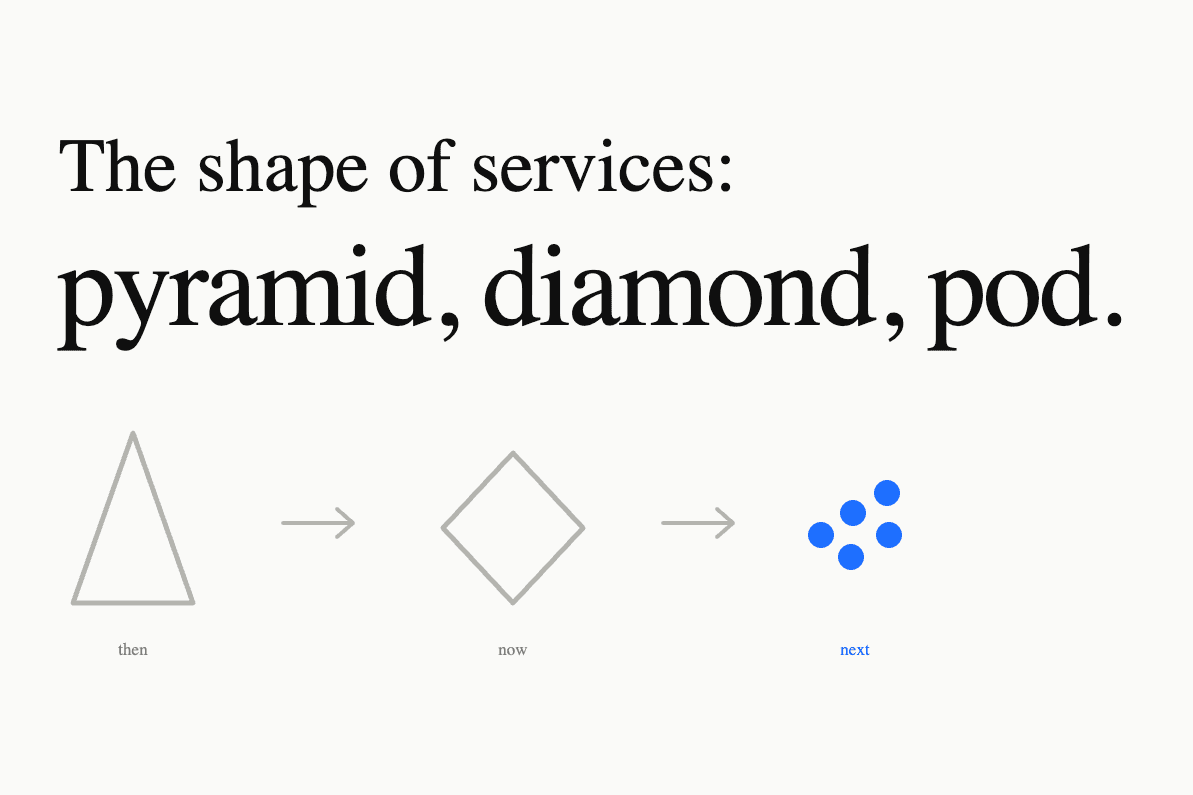
And the shape changes, in two steps, not one. The first step is already visible. As the grinding goes agentic, the pyramid becomes a diamond: thin at the base, heavy in the middle, where the people live who have enough judgment to direct agents and enough hands-on skill to catch a confident wrong answer. Most firms will stop here and declare victory, and I understand why. The diamond matches where the margin sits today. But the diamond is what a pyramid looks like mid-melt, not a destination. The middle's work, structuring engagements, orchestrating delivery, reviewing output, is exactly what agents eat next. And the diamond carries a career problem the pyramid never had: a wide middle under a narrow top is a logjam, and your most ambitious people are precisely the ones who leave logjams.
The stable end state is the pod: a few senior people with real judgment, a fleet of agents, an eval harness as the quality floor, and one deliberate apprentice. Small, dense, senior-heavy. Thirty people producing what three hundred did, and the three hundred was the point of the old shape.
III.
Two observations from the floor. First, the constraint flips. For eighty years the binding constraint of a services firm was capacity, and every ritual of the industry, the utilization targets, the bench, the staffing calls, exists to manage it. In an agent-native firm, capacity is nearly free and the binding constraint is judgment: knowing what good looks like, catching the confident wrong answer, deciding what not to build. You can feel the flip in the P&L. Revenue stops tracking headcount. Revenue per person, not headcount, becomes the number that tells you whether a firm has actually rebuilt or just bought licenses.
Second, the honest problem nobody in the industry has solved: the pyramid was the school. If agents do the grinding, where does the next generation of judgment come from? Grinding was never busywork; it was ten thousand low-stakes reps that slowly compiled into taste. This is why the pod keeps its one apprentice on purpose, even though the seat is economically irrational: juniors now train on reviewing agent output, running evals, and interrogating work rather than producing it, the way pilots train in simulators at rep volumes no cockpit could offer. I hold that answer loosely. Any services leader who claims certainty here is selling something.
IV.
What this means if you buy services rather than sell them: the rate card is now a diagnostic. A firm still quoting per-hour pyramids in 2026 is telling you, in writing, that its cost structure has not changed, which means either its margins are quietly exploding at your expense or its delivery has not actually moved.
And the market direction: the incumbents are trapped by their own geometry, because the pyramid is not just their org chart, it is their P&L, and every efficiency gain destroys billable hours somewhere on their own income statement. They will adopt agents in the way that protects the shape, which is to say partially: expect a decade of proudly announced diamonds. Meanwhile the model labs and clouds are pouring billions into deployment ventures that are, in effect, services firms born without pyramids. The squeeze comes from both ends, and the middle of the services industry gets the same choice I wrote about for mid-market companies generally: reprice yourself, or be repriced.
The pyramid was never the point. Judgment was always the product, and the pyramid was simply the best amplifier the twentieth century could build for it. A better amplifier now exists. The firms that mistake the shape for the substance will spend the next five years defending whatever shape they are currently in. The firms that remember what they actually sell will melt it down themselves, and pour it into something smaller, denser, and worth more.