Rebuild the House
Somewhere around 2017, at a family dinner in my home town in Gujarat (India), an uncle asked me what I actually did for a living. I said "cloud consulting" and he had no idea what that meant. So I reached for an analogy, and it worked so well that I've been using it for a decade since. Cloud computing, I told him, is like the plumbing of a house. The wiring, the cement, the water supply, the foundation. Nobody falls in love with a house because of its plumbing, but no house works without it. The applications a company builds, the things employees and customers actually touch, those are the house. My job was to sell the pipes and wiring and concrete so that our customers could build whatever house they wanted on top. Sometimes, we also helped them build part of the house.
The analogy went surprisingly deep. Before the cloud, every company dug its own well and ran its own generator. That was the data center era. Cloud was the arrival of municipal water and the power grid: you stopped worrying about generation and just paid for what flowed through the meter. Even the job titles lined up. The person who designs how it all fits together is literally called a solutions architect. My uncle nodded. He got it. For ten years, this was my mental model of the industry, and it was accurate.
Here is the thing about that decade, though. When companies "moved to the cloud, " they were re-plumbing. Lift-and-shift, we called it, and the name gives the game away: you lifted the existing house and shifted it onto new pipes. The house itself barely changed. The ERP still had its four hundred screens. The approval workflow still had its seven steps. We swapped the water supply and called it transformation, and for that era, it was. The economics of the plumbing had changed; the logic of the house had not.
What is happening now is different in kind, not degree, and most enterprise leaders haven't fully absorbed it yet.
The materials changed
Every so often in construction, a new material arrives that doesn't just improve buildings. It changes what a building is. When steel frames showed up in the late nineteenth century, nobody renovated their five-story masonry buildings into skyscrapers. You couldn't. A masonry building holds itself up with thick load-bearing walls; a skyscraper hangs its walls off a steel skeleton. The skyscraper was not a better version of the old building. It was the shape that became possible once an old constraint disappeared.
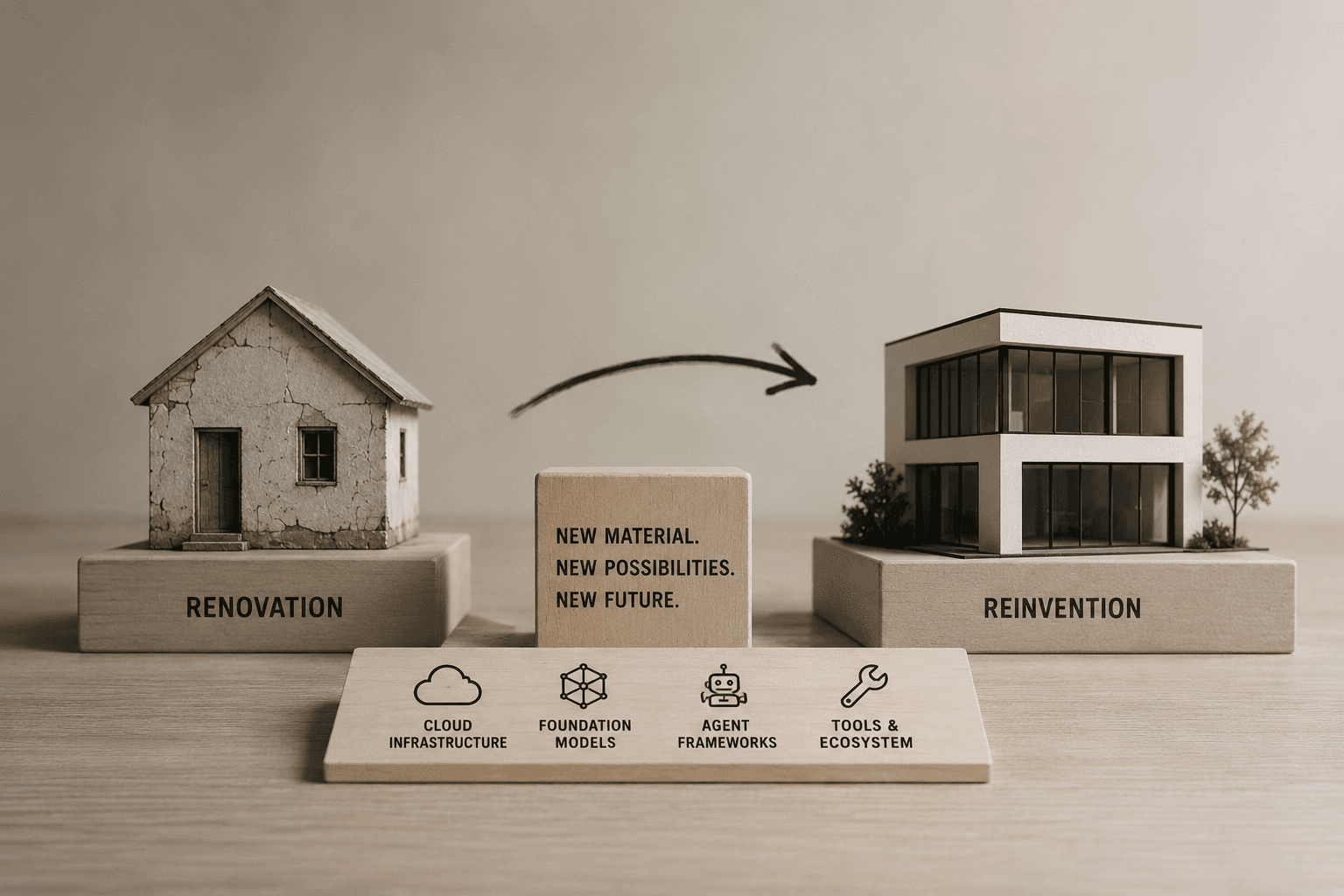
Large language models, together with the cloud underneath them and the growing harness of agent frameworks and tooling around them, are that kind of material. They are the new plumbing and wiring, yes. But they remove a constraint so fundamental that the optimal shape of the house changes.
Think about what every enterprise application actually is. A form. A dashboard. A ticket queue. An approval chain. Strip away the branding and it is all the same artifact: a structure built around the assumption that software cannot think, so humans must. The form exists because the system couldn't understand a sentence. The dashboard exists because the system couldn't tell you what mattered. The ticket queue exists because judgment was scarce and had to be rationed. Four hundred screens in an ERP is not a design choice. It is a monument to a constraint.
That constraint is gone. Which means the houses we spent thirty years building are now the wrong shape.
The retrofit trap
The natural instinct, when the wiring improves, is to keep the house and upgrade the fittings. This is what most enterprises are doing right now. Bolt a chatbot onto the ERP. Add a copilot to the seven-step approval flow. Sprinkle "AI features" across the existing screens.
This is installing a smart speaker in a house wired in 1955. It works, technically. It even demos well. But you are asking a new material to live inside an architecture built around its absence, and the results show it: a few percentage points of productivity, a summarization feature, and a nagging boardroom question about why the miracle technology isn't producing miracles.
History has a precedent for exactly this. When factories swapped their steam engines for electric motors but kept the same layout, productivity barely moved for thirty years. The gains only arrived when engineers put a small motor on every machine and rebuilt the factory floor around the work instead of the power source. The renovation produced nothing. The rebuilt factory changed the century.
The money has already figured this out
If you want to know where value will accrue in a technology shift, watch where the most informed capital goes, especially capital deployed by the people who own the technology itself. You have probably seen the announcements. In the span of a single quarter, OpenAI, Microsoft, AWS, Anthropic, Google and Salesforce collectively committed roughly ten billion dollars to forward-deployed engineering ventures: teams whose entire job is to embed inside enterprises and rebuild their operations. Analysts expect over a trillion dollars to flow through the systems-integration market this year.
Notice what's strange about that list. These are the companies that own the materials: the models, the chips, the clouds. The most valuable plumbing in history. And they are pouring billions into what is essentially construction crews.
Why would the cement companies suddenly buy masons?
Because they can see the data most enterprises are still learning the hard way: the models are extraordinary and the deployments are failing. Only around a third of leaders report sustained, enterprise-wide impact from AI. Pilots stall. Proofs-of-concept die in committee. The reason is not the technology. A pilot bolted onto an old house is a renovation, and renovations don't produce skyscraper returns. The model makers have realized that the value of their materials is capped by the world's capacity to rebuild, so they are funding the rebuilding themselves.
There is a second thing the capital has noticed, and I'll mention it only as a side note because it is the builders' business model, not yours. A software house, once built, mostly just stood there. This new house is alive. The models underneath it improve every quarter. The agents inside it need supervision, evaluation, retuning. It is less a building than a garden, and gardens need gardeners on a permanent basis. That is why the firms doing the rebuilding earn recurring revenue that looks more like software than services, and why investors have started pricing them accordingly. The maintenance contract on the new house may be worth more than the construction.
But that is the economics of the builders. The bigger decision belongs to the owners.
The question is wrong
If you lead an enterprise right now, the question on your board deck is probably some version of "where can we add AI?"
That is a renovation question. It takes the existing house as given and looks for rooms to upgrade. It will produce exactly what renovation questions always produce: incremental gains, respectable pilots, and a company that is 8% more efficient at being what it already was.
The question worth asking is the zero-based one: if this company were founded this year, what would we build? Which departments exist only because software couldn't read? Which processes are elaborate queues for rationing human judgment that no longer needs to be rationed? Which of your four hundred screens would survive if the system could simply be told what you want? Sit with those questions and the answer is rarely "our current operating model, plus a chatbot. "
The rebuild is not easy. You have to live in the house while reconstructing it: real customers, real regulators, real payroll every month. Nobody sensible bulldozes on day one. You rebuild wing by wing, one process, one function, one P&L at a time. But there is a world of difference between renovating wing by wing toward a blueprint of a new house and renovating toward a nicer version of the old one. The blueprint has to be zero-based even when the construction is incremental.
And the clock is ticking either way. Somewhere right now, a competitor is being founded with no house to protect. No legacy screens, no seven-step approvals, no monument to the old constraint. Their entire company is organized around what the new material makes possible. When they show up in your market, you will not be competing against a better version of yourself. You will be competing against a different shape.
My uncle, by the way, still asks me what I do. These days I tell him the analogy has changed. The material itself has changed so profoundly that every house in the city needs to be rebuilt. And now, we build the house :)