TL;DR
- Product data, digital assets, and CMS content living in separate systems is the default state of most enterprise applications — and it creates constant reconciliation overhead.
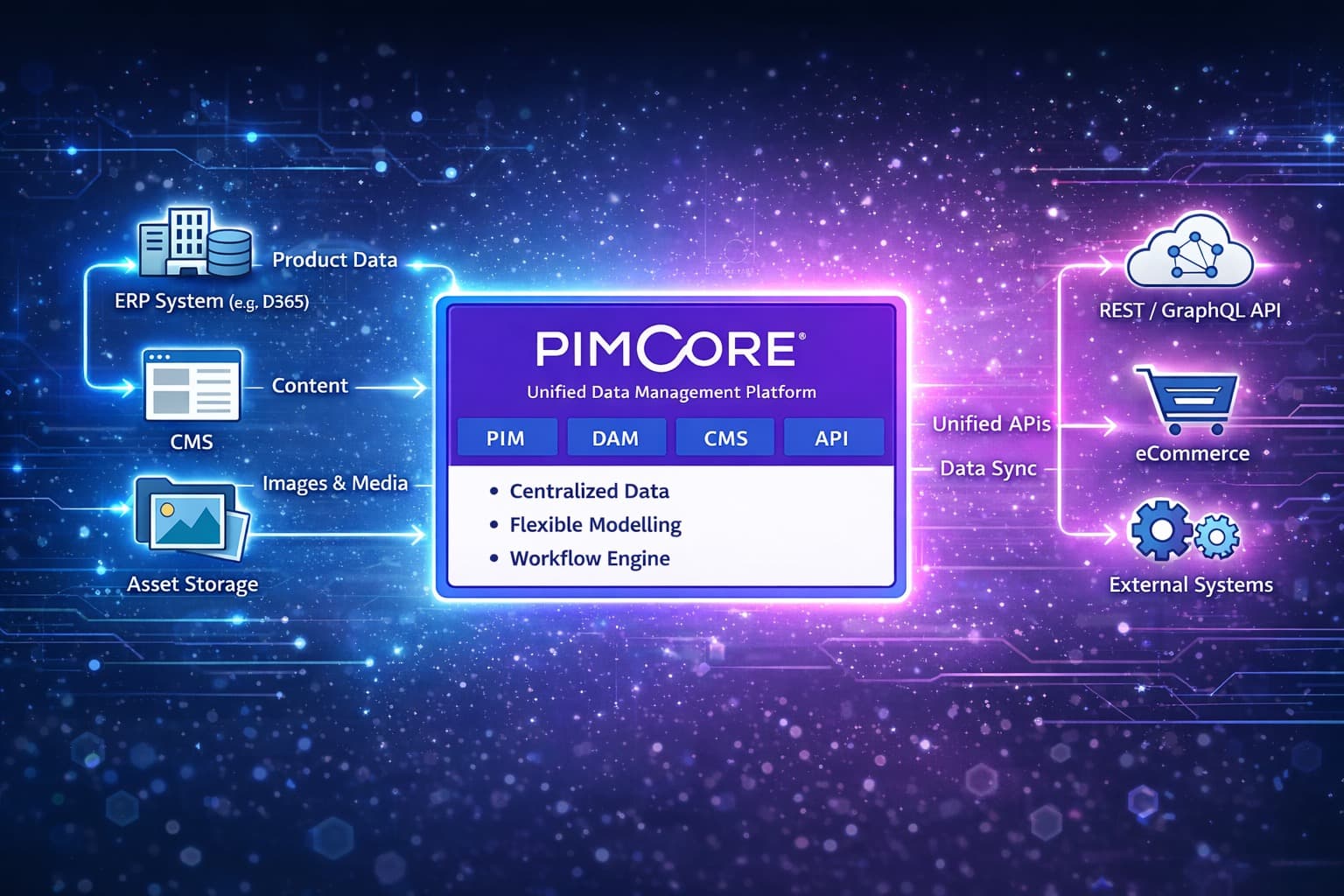
- Pimcore is an open-source platform that combines PIM, DAM, CMS, and an API-first data layer into a single system, eliminating the duplication and sync issues that come with fragmented stacks.
- Custom data models let you define exactly the schema your business needs — nested objects, variants, classifications, relationships — without fighting a rigid template.
- Built-in REST and GraphQL APIs mean you never need to build a separate integration layer just to feed your frontend or mobile app.
- Pimcore is the right choice when your data is complex, your integrations are many, and consistency across systems is non-negotiable. It is not the right choice for a simple CRUD app.
The Stack That Looks Fine Until It Does Not
Here is a setup we encounter constantly in production systems: product data lives in an ERP (Microsoft Dynamics 365 is common), media assets live in a separate storage system, content is managed in a standalone CMS, and the APIs that tie everything together were built one at a time, each by a different team, each with a slightly different understanding of what a "product" actually is.
You end up with a SKU that exists in the ERP but has no corresponding entry in the CMS. A product where the brand attribute is populated in one system and blank in another. Images that are stored in the DAM but not correctly linked to the product records they belong to. And a growing collection of sync scripts that no one fully trusts but everyone is afraid to touch.
The problem is not that any individual system is bad. The problem is that none of them were designed to be the authoritative source of truth for the whole stack. And once you have four or five systems all maintaining their own version of the same product, the maintenance cost compounds fast.
What Breaks When Data Is Fragmented
The symptoms are predictable once you know what to look for.
Data duplication. The same product attribute — a description, a category, a brand name — gets stored in three different places. The moment someone updates one and not the others, you have inconsistency baked into your system.
Synchronization failures. Custom sync scripts handle the "write to ERP, propagate to CMS" flow. These scripts break on schema changes, fail silently on partial writes, and have no built-in retry or conflict resolution. Every failure requires manual investigation.
Missing mappings. A product image exists in storage. A product record exists in the ERP. Nothing maps one to the other because they were created in different systems by different teams at different times.
Integration sprawl. Every new consumer of product data — a mobile app, a new frontend, a third-party marketplace integration — requires a new bespoke integration built against whichever upstream system happens to have the data that consumer needs.
Each of these is solvable in isolation. Combined, they add up to a system where developers spend more time maintaining consistency than building new things.
How the Data Model Works
This is where most teams either win or lose their Pimcore implementation.
Pimcore uses an object-oriented data model. You define classes — think of them as schemas — through the admin UI or programmatically. A Product class might have fields for name, SKU, description, and dimensions, plus a relation to a Category object and a multi-value field for images pulled from the DAM.
// Accessing a product object in Pimcore
$product = DataObject\Product::getById(42);

echo $product->getName();         // "Running Shoe Pro X"
echo $product->getSku();          // "RSP-001-BLK-42"
echo $product->getBrand();        // "ACME Athletics"

// Fetching linked assets (DAM integration)
$images = $product->getImages();
foreach ($images as $image) {
    echo $image->getFullPath();   // /product-images/running-shoe-pro-x/front.jpg
}

// Fetching related category
$category = $product->getCategory();
echo $category->getName();        // "Footwear > Running"
Where this matters most is variants. A product with 40 size-color combinations is not 40 separate product records — it is one parent object with 40 variant objects, each inheriting the parent's shared attributes and overriding only the fields that differ. Pimcore handles this as a first-class concept.
Classifications let you attach dynamic attribute groups to objects at runtime. A Product in the footwear category gets a different attribute set than a Product in electronics — without requiring separate classes or schema migrations.
The Asset Layer
The DAM is not a bolt-on. Assets in Pimcore are first-class objects with their own metadata, versioning, and workflow state. When a product image is uploaded to the DAM, it can be linked directly to one or more product objects. When the image is updated, every product referencing it reflects the change automatically.
Pimcore handles thumbnail generation and transformation rules declaratively:
// Thumbnail profiles are defined once in admin UI or config.
// Pimcore generates the variant on demand.
$thumbnail = $image->getThumbnail('product_listing');
echo $thumbnail->getPath();
// /product-images/running-shoe-pro-x/front__thumb_400x400.jpg
You define named thumbnail profiles (dimensions, crop mode, format) once. Every image in the system can be served in any defined profile on demand. No custom image processing pipeline to maintain.
API-First by Default
Every data object and asset in Pimcore is accessible through the Data Hub via GraphQL. You configure an endpoint — define which classes are exposed, which fields are queryable, which require authentication — and Pimcore generates the GraphQL schema automatically.
# Query products with their linked assets
query {
  getProductListing(
    filter: "{ \"o_published\": { \"$eq\": true } }"
  ) {
    edges {
      node {
        id
        name
        sku
        brand
        category {
          name
        }
        images {
          fullpath
        }
      }
    }
  }
}
The same endpoint feeds a React frontend, a mobile app, and a third-party marketplace integration. No separate API layer. No duplicated data transformation logic per consumer.
Integrating With External Systems
Pimcore does not exist in isolation. The realistic architecture is Pimcore sitting alongside an ERP and an eCommerce platform, with data flowing between them.
The pattern we use: Pimcore owns product master data — what a product is — while the ERP owns operational data — pricing, inventory, financial records. When a product is created or updated in Pimcore, an event is published to a message broker. The ERP subscribes and creates its own SKU record. The eCommerce platform subscribes and creates a product listing using Pimcore's enriched content.
// Event listener: publish to message broker on product save
class ProductPublishListener
{
    public function onPostUpdate(Event $event): void
    {
        $product = $event->getElement();
        if (!$product instanceof DataObject\Product) {
            return;
        }

        $this->messageBroker->publish('product.updated', [
            'id'   => $product->getId(),
            'sku'  => $product->getSku(),
            'name' => $product->getName(),
        ]);
    }
}
The ERP never writes back to Pimcore's product attributes. Pimcore never writes back to the ERP's pricing tables. Domain ownership is explicit and enforced at the integration layer.
Workflow and Data Governance
Pimcore has configurable workflow support for managing the lifecycle of any data object. A product goes through Draft, Review, Approved, and Published states. Transitions require specific roles. Notifications fire on state changes.
This directly solves the problem of unreviewed data going live. A product that has not cleared the approval workflow cannot reach the Published state — and nothing in the Published state is stale or unreviewed.
When Pimcore Is the Right Choice
Use Pimcore when:
- You are managing complex, hierarchical product data with variants, classifications, and cross-entity relationships.
- Multiple external systems need to consume the same product data, and you want one governed source of truth instead of N point-to-point integrations.
- You need centralized asset management tightly coupled to the data that references those assets.
- Workflow-gated data publishing — approval chains, role-based editing — is a requirement.
- You are self-hosting and need full control over data storage and access.
Do not use Pimcore when:
- Your application has simple, flat data with no relationships and no integration requirements.
- Your dataset is small and unlikely to grow in complexity. Pimcore's data modeling features are powerful, but they require design effort. That cost is only worth paying if the complexity exists.
- Your team has no PHP/Symfony familiarity and no budget to build it. Pimcore is not the kind of system you set up in a weekend.
What to Get Right Early
The most common implementation mistake is designing the data model after you start loading data. Changing a class structure once objects exist in Pimcore is possible but painful — it requires data migrations and potential re-indexing of the search layer.
Get the following right before you import anything:
Class hierarchy. Define what is a standalone object vs. a nested object vs. a relation. Avoid embedding data in a class that logically belongs to a separate entity.
Variant structure. Decide which attributes live on the parent product and which on the variant. This is hard to change later without data migration.
Asset naming conventions. Pimcore uses folder paths as organizational structure in the DAM. Establish a convention before assets are uploaded — changing paths later breaks links.
Workflow states. Define the states a product goes through and which roles can trigger which transitions. Adding new states later is easy; removing states that already have objects in them is not.
Validation rules. Field-level validation (required fields, format constraints) should be configured in the class definition, not enforced solely at the application layer. Pimcore will reject writes that violate class-level validation, which catches inconsistent data at the source.
The Payoff
A well-implemented Pimcore setup replaces a collection of fragmented systems and custom sync scripts with a single governed data platform. Developers stop writing data reconciliation code and start building features. The data consumers — frontends, mobile apps, third-party integrations — all pull from the same GraphQL endpoint with the same field names and the same guarantee that what they get has been through the approval workflow.
The upfront design cost is real, but it pays for itself once the data platform is stable and teams stop writing reconciliation code.